Blog

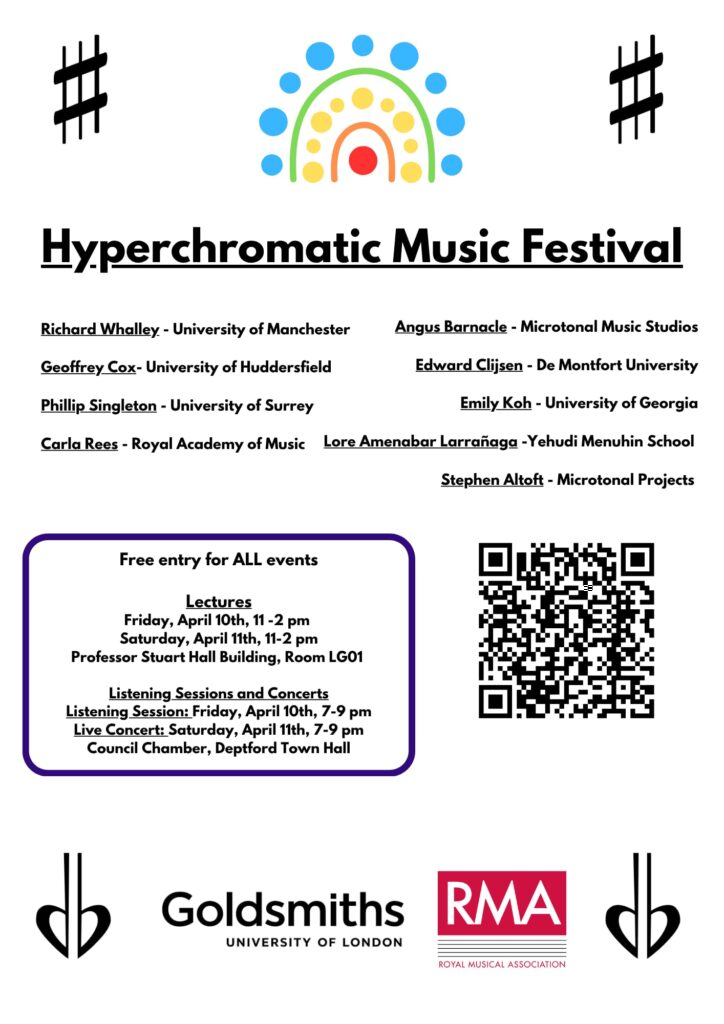
  • Hyperchromatic Festival 2026

    Goldsmiths University London, 10th & 11th April, 2026

    The first microtonal festival in London sind UKMicroFest 4 in 2012! The first microtonal festival in the UK since ‘Beyond the Semitone’ in Aberdeen in 2013! Hyperchromatic Festival returns in 2026, organised by our partner-in-microtones, Joseph Gusmano!

    The festival opens on 10th April with afternoon lectures and an evening Listening session. On 11th April the afternoon lectures continue with a concert in the evening to round the festival off.

    Call: HC invites composers to submit digital recordings (audio, video or midi) of their microtonal works, to be exhibited as part of a listening session. Submit by 10th March per drive link to jhgusmano@gmail.com

    Brilliant opportunity in London to meet up with like-minded people, watch lectures and hear live microtonal music.

  • Untwelving

    Convention for contemporary microtonal and xenharmonic music of all genres

    22nd–24th May, 2026 
    Münchner Kammerspiele & FatCat
    , Munich (DE).


    The call is now open. 
    All information about categories, deadlines, and submissions can be found here

  • Happy Birthday Donald, 2025!

    To honour the birthday of our dear friend and founder, Donald Bousted, Microtonal Projects has added his PhD to the Microtonal Projects Resources Folder on Dropbox. His daughter, Dorothy was delighted to give us permission to do this. It is entitled, ‘Rhythmic, diatonic and microtonal structures in musical composition: method and notation, 1993-1998’, (2001).

    If you would like to have access to this- which contains lots of information about microtonal topics, then request it at info.microtonalprojects@gmail.com

  • TRINATIONAL MICROFEST 2025

    Germany, France, Switzerland

    22th November – 30th November 2025

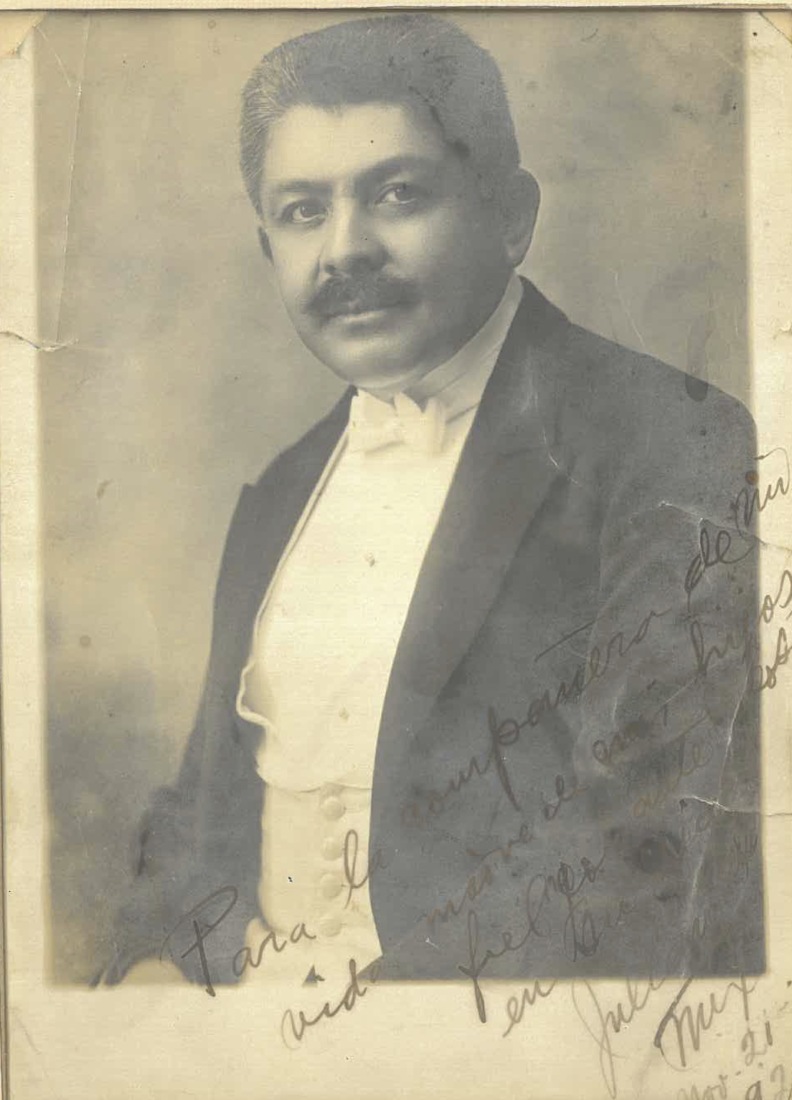
    In honor of the Mexican composer Julián Carrillo (1875-1965) on his 150th birthday.

    The “Trinational MicroFest” celebrates the artistic, cultural and personal exchange between three countries. A new story that connects France, Switzerland and Germany through music and that builds a bridge between the musical heritage of microtonality and the latest approaches from current composers who explore the possibilities of this thinking of sound in order to share it with a curious audience.

    In collaboration with various institutions, musicians and musicologists from France, Switzerland and Germany as well as international partners from Carrillo’s home country Mexico and Latin America, the festival presents various activities related to the music of Julián Carrillo: concerts, lectures, symposiums, exhibitions, educational projects and a competition for female composers in the form of a “Call for scores”. In addition, the festival presents works with numerous premieres by current composers, particularly from France, Switzerland, Germany and Latin America, with a focus on special microtonal instruments.

    The “Trinational MicroFest” invites you to powerful and surprising experiences. When you hear microtonal music and instruments for the first time, it leaves a lasting impression!

    “This moment marked my fate. […] The previously known cycle of twelve tones that were only related to each other was broken and opened the doors to infinity for music.” Julián Carrillo

  • NOW and XEN Podcasts

    This summer, the Stephen Weigel interviewed Stephen Altoft about the Microtonal Trumpet project and Microtonal Projects’ work. Listen to the podcast here.

    ‘Now and Xen is the microtonal podcast – launched by Sevish, and now run by Stephen Weigel. We talk to seasoned veterans of microtonal music about the techniques they use to play their instruments, music theory, composition, performance, education, and the role of microtonality in society. We generally focus on contemporary music, though we dig into older music quite a bit as well. If the Patreon account gets to 60, we will create monthly episodes!’

  • Homenaje a Salinas

    NEW RELEASE ON STREAMING PLATFORMS!

    Homenaje a Salinas
 by Jim Dalton, for 19-div flugelhorn – played by Stephen Altoft- is now available on Spotify, Apple Music etc. The sound engineer and producer was Vasiliki Kourti-Papamoustou.

    Homenaje a Salinas


    When I think about 19-tone equal tuning, the 16th century Spanish music theorist and organist Francisco de Salinas is never far from my thoughts. He was the first to clearly define the form of tuning called 1⁄3-comma meantone (which is very closely approximated by dividing the octave into nineteen equal parts). In this composition I chose to honor Salinas with three movements inspired by the Spanish baroque. The number nineteen is represented in different ways in each movement — sometimes overtly, sometimes not.

    1. Preludio sin compases — This is an unmeasured prelude, a form popular in France; however it has a few elements of “harmonic labyrinth,” a feature that I have seen frequently in Spanish baroque guitar music. My version of the labyrinth moves through all of the nineteen tones.
    2. Zarabanda — a form brought to Europe from Central America by the Spanish. It is first mentioned during Salinas’ lifetime. The rhythmic form of the dance seems to have evolved over time. I use the rhythm of the sarabande as it had evolved by the late Baroque.

    III. Canarios Extraños — a dance form with roots in the Canary Islands. The original canarios was a 6/8 rhythm with groupings of eighth notes shifting between groups of two and three.

    I maintain the interplay of twos and threes but use a meter of 19/8.

    James Dalton is an American composer and performer. He has been a professor of music theory at the Boston Conservatory at Berklee since 2000.

    Dalton’s compositions have been performed throughout the United States, Canada, and Europe by the Providence Mandolin Orchestra, Enigmatica, Toronto Camerata, Ensemble Decadanse, Transient Canvas, Scottish Voices, Sharan Leventhal, Stephen Altoft, Paul Ayres, Aaron Larget- Caplan, Michael Nix, Donald Bousted, and Carson Cooman; and at such venues as the National Cathedral (Washington, D.C.), the Kansas Symposium of New Music, Musiques Nouvelles (Lunel, France), EUROMicroFest, Sound (Festival of New Music, Scotland), Fifteen Minute of Fame (various cities and online) and Akademie der Tonkunst (Darmstadt, Germany).

    He studied composition with George Walker, Louie White, Neely Bruce, Robert Dickow, and Daniel Bukvich; and guitar with Michael Newman and John Abercrombie.

    Dalton’s compositions have been published in anthologies for carillon, organ, guitar, and mandolin. His works have been recorded by Michael Nix, Donald Bousted, Carson Cooman, Aaron Larget-Caplan, Stephen Altoft, Enigmatica, and the New England Mandolin Ensemble. Two of his text scores are published in the anthology, A Year of Deep Listening (Terra Nova Press, 2025).

    As a music theorist (as well as composer), Dalton’s interests and research have ranged from palindromes and symmetrical musical structures to just intonation and microtonality. He has presented at conferences in the United States and abroad, including the Society for Ethnomusicology, the Society for American Music, “Beyond the Semitone” (Aberdeen, Scotland), the 17th International Music Theory Conference (Vilnius, Lithuania), the Nova Contemporary Music Meeting 2018 (Lisbon, Portugal), Mikrotöne: Small is Beautiful 2021 and 2023 (Salzburg, Austria) and The Microtonal Village 2024 (NYC).

  • Echoes

    Stephen Altoft’s improvisation duo with the Belgian guitarist, GIlbert Isbin has just begun releasing their third project on YouTube- ‘Echoes’. Whilst their previous collaborations included some tracks microtonal trumpets and flugelhorn, this is the first time that the guitar has become microtonal for some tracks- combining quarter-tones on both trumpet or flugelhorn, with detuning the the three lower strings of the guitar.

    Echoes 3

  • Pseudo Relations

    NEW RELEASE ON STREAMING PLATFORMS FROM TODAY!

    Pseudo Relations by Isak Persson for 19-div trumpet – played by Stephen Altoft- is now available on Spotify, Apple Music etc. The sound engineer and producer was Vasiliki Kourti-Papamoustou.

    Microtonal Project’s Records are releasing a track monthly until the summer on all major streaming platforms.

    Isak Persson was born in Helsingborg in Sweden in 2003. At 10 years old Isak picked up the guitar, and throughout the years he has played both electric guitar and classical guitar. By the end of elementary school Isak began to transition from writing electric guitar riffs to writing contemporary classical pieces.

    Isak is currently taking a bachelor in composition at the Royal Danish Academy of Music in Copenhagen. Before RDAM he was studying music at Malmö Latinskola for three years, there his main instrument was guitar and he studied composition as a subsidiary subject. 

    Isak’s music has been performed by himself, Red-Note Ensemble, Vindla String Quartet, Esbjerg Ensemble and more.

  • Furano Sax Quartet

    The Italian sax quartet, Furano, have been collaborating with us for a couple of years, on putting together a quintet programme with quarter-tone trumpet.

    There are currently pieces for quarter-tone trumpet and sax quartet by Daniele Bravi, Vasiliki Kourti-Papamoustou (based on Donald Bousted’s Microtonal Studies)and Alberto Napolitano. In addition there is a graphic score piece by Stephen Altoft for sax quartet.

    Last year Stephen travelled to Foggia, Italy to make a recording and a video demo of La Fragilità del Riflesso by Daniele Bravi.

  • Dialogue

    Microtonal Project’s Records are releasing a track monthly until the summer on all major streaming platforms. Paul Rhys’s ‘Dialogue is now also out!

    ‘I am delighted to have (so far) given three performances of thiswork- at Churchill College (Cambridge), at EUROMicroFest (Freiburg, Germany) and Hyperchromatic Festival (London). Now more people can have access to this piece, which has been a joy to work on with Paul over the last few years.’ (Stephen Altoft)

    Paul Rhys – Dialogue for Trumpet

    In this piece a 19-note trumpet enters into dialogue with a computer soundtrack created using granular synthesis by fractal organization. The soundtrack uses two brief recorded sounds, one of them a single drop of water. I am grateful to Anglia Ruskin University for funding the research leave that enabled the creation of this piece. I am also very grateful to the extraordinary trumpeter Stephen Altoft who developed the 19-note trumpet and has since encouraged a wide community of composers to write for the instrument.

    Paul Rhys was born into a musical family but read sciences at Oxford before turning to postgraduate study as a composer in the UK and US. He has taught at Reading University, at Clare College Cambridge, and currently teaches at Anglia Ruskin University. His early electronic work Ebb and Flow gained a Bourges Residency prize. Soon after, a Wingate Foundation Scholarship funded a year of study at Northwestern University in the US where he completed Chicago Fall for mixed acoustic and electronic ensemble, later performed at the Pompidou Centre in Paris. His virtuoso piano solo Not I follows the structure of Samuel Beckett’s monologue and has been performed internationally by pianist Ian Pace, who also premiered Rhys’ Piano Concerto in London. Since 2017 he has been composing music in 19 divisions of the octave, gradually developing theory, practice, and software in a series of works for voices and instruments setting sacred texts from the Baha’i writings.